About
Louis Brüls (1803–1882) was a 19th-century painter active in the Rhineland, the Low Countries, Germany, and Italy. He trained at the Royal Academy of Fine Arts in Antwerp and later worked in Munich and Rome. Variants of his name were extensive: he was baptised Ludovicus Josephus Brüls and also recorded as Louis Joseph Bruls, Ludwig (Josef) Brüls, and in Italian as Lodovico, Ludovico, or Luigi Brüls.
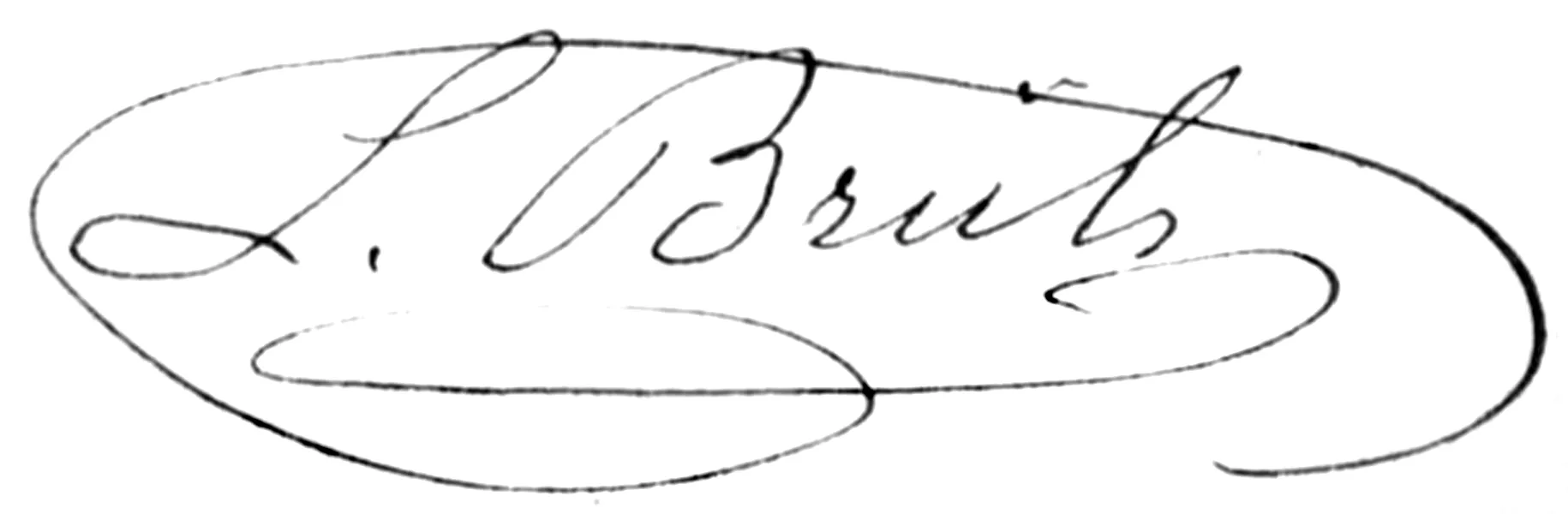
Born at Gut Drinhausen near Übach, in what was then French-administered Rhineland, Brüls later became a subject of the United Kingdom of the Netherlands and, after the Belgian Revolution of 1830, chose Belgian citizenship. He kept it for the rest of his life. In his own correspondence, he called himself an artiste belge, and he signed his work Louis Bruls, the French form of his name. The political changes he lived through, and the five languages in which his records were written, produced wide variations in his name and no end of confusion in later art-historical references.
The scale of that confusion is striking. His first name survives in ten forms, from the Latin "Ludovicus" of his baptism to the Italian "Luigi" of his Roman years, and his surname in at least seven, including a garbled "Brunts" that gave him a second, phantom identity in American collections. No version was ever settled as correct.
These inconsistencies probably explain why Louis Brüls became so hard to trace. His native Übach passed from French rule to the United Kingdom of the Netherlands, and then into the disputed territory of Limburg after Belgian independence. Each change brought a new administrative language and a new form of his name, across documents in Latin, German, Dutch, French, and Italian. Even his tomb in Rome says, incorrectly, that he was born in Brussels. His death certificate adds to the uncertainty: it gives his birthplace only as "Belgium," with the town left blank.
Fortunately, a collection of genealogical materials compiled by descendants of the Brüls family from the 1950s onward has been found, revealing many new facts as well as confirming details stated by earlier historians. Jacques Dufrasne, a great-great-grandnephew of the painter and a member of the Institut Archéologique Liégeois, compiled genealogical diagrams and a handwritten catalogue of known paintings.
Dr Léon Hucklenbroich and his sister, Marie-Louise Hucklenbroich, both descendants of Brüls's elder brother Jean-Joseph, continued the work from Brussels: he assembled a typed biographical dossier with photographs of the tomb, a works list, and family correspondence; she contributed biographical notes and an independent family genealogy. Marie-Louise Hucklenbroich was my grandmother, and the family archive eventually passed down to me.
Art auctions, both recent and historical, have often carried inaccurate titles, wrong biographies, and occasional misattributions of Brüls's work to painters of similar subjects. Modern research has been essential to correcting this record.
Rieke van Leeuwen's 1985 study of Low Countries artists in Florence was the first to identify the two separate Thieme-Becker entries as the same individual. Frank Pohle's 2008 publication developed the evidence further and formally resolved the bibliographical split that had long distorted Brüls's identity.
Brüls was more than a painter. In 1861–62, he was formally accredited as an agent of the Belgian State, working with the Belgian diplomat Henri Carolus on a nine-month acquisition mission in Rome, purchasing old masters for the Royal Museum in Brussels. He was also active in the private antiquities trade, sourcing Greek and Etruscan vases for collectors such as the Basel scholar Johann Jakob Bachofen. His own collection of antiquities was purchased in 1861 for the University of Würzburg as the founding acquisition of the Martin von Wagner Museum.
He received official recognition more than once. He was awarded a silver-gilt medal at the Brussels Salon of 1848 for his painting L'Enfant malade.
In 1862, he was made a Knight of the Order of Leopold for helping the Belgian State acquire works of art and antiquities in Rome, including seventy-seven Greek and Etruscan vases from the Campana reserve.
In 1864, Brüls produced one of the most important works of his career: a portrait of Pope Pius IX, for which the Pope sat in person.
By 1866, his name was carved on a marble plaque in San Giuliano dei Fiamminghi, the Belgian national church in Rome, alongside the Belgian Ambassador, the Belgian Consul, and a Papal Almoner. He served as one of the church's six wardens.
His painting Der Segensspruch, also catalogued as Le Sauveur bénissant (Christ Blessing), entered the royal Bavarian collection and hung in the Neue Pinakothek in Munich alongside works by Overbeck, Schadow, and Schraudolph.
Although he exhibited in Antwerp, Brussels, and Rome, and was well placed in the Belgian community in Rome, Brüls did not achieve lasting prominence in mainstream art history. His work circulated mainly among private collectors, church patrons, and institutions rather than through a sustained public presence.
He died in Rome on 19 December 1882, after more than four decades based in the city. His widow, Anna Maria Micocci, commissioned a marble tomb at the Cimitero del Verano, which bears sculpted profile medallions of husband and wife. His surviving works and the archival record left behind him point to a life spent crossing borders, changing languages, and working steadily within the religious and artistic world of 19th-century Europe.